Why Fable 5 is the New Gold Standard for Generative Web Design
The era of manual, static web design is rapidly caving to a new reality: the age of generative, immersive experiences. For years, the industry has chased the “holy grail” of moving from a simple prompt to a fully functional, high-fidelity production site. With the release of Anthropic’s Fable 5, that transition hasn’t just arrived; it’s arrived with a level of technical sophistication that caught even seasoned strategists off guard. After extensive hands-on testing, it’s clear that we are no longer just looking at “AI layouts”—we are looking at the birth of the autonomous creative engineer.
Orchestrating the Impossible: Native 3D and Library Mastery
In the past, AI struggled with the specialised syntax required for advanced motion. Generating a layout was easy; orchestrating complex libraries like 3JS and GSAP (GreenSock Animation Platform) to handle scroll-triggered animations was a nightmare. Fable 5 has shattered this ceiling.
During testing, a single prompt for an “award-winning site” resulted in a sophisticated environment featuring a 3D butterfly fluttering through a cloud of light particles and a solar system where planets moved with surgical precision in response to user scrolling. This isn’t just “good for AI”—as the hands-on evaluation noted, “this is probably one of the best looking websites I’ve actually generated from a single prompt.” For design strategists, the takeaway is clear: the technical hurdle of creative coding is being democratised, allowing non-developers to jump directly from concept to high-end motion design.
From Layouts to Logic: The “Design Skill” Agentic Revolution
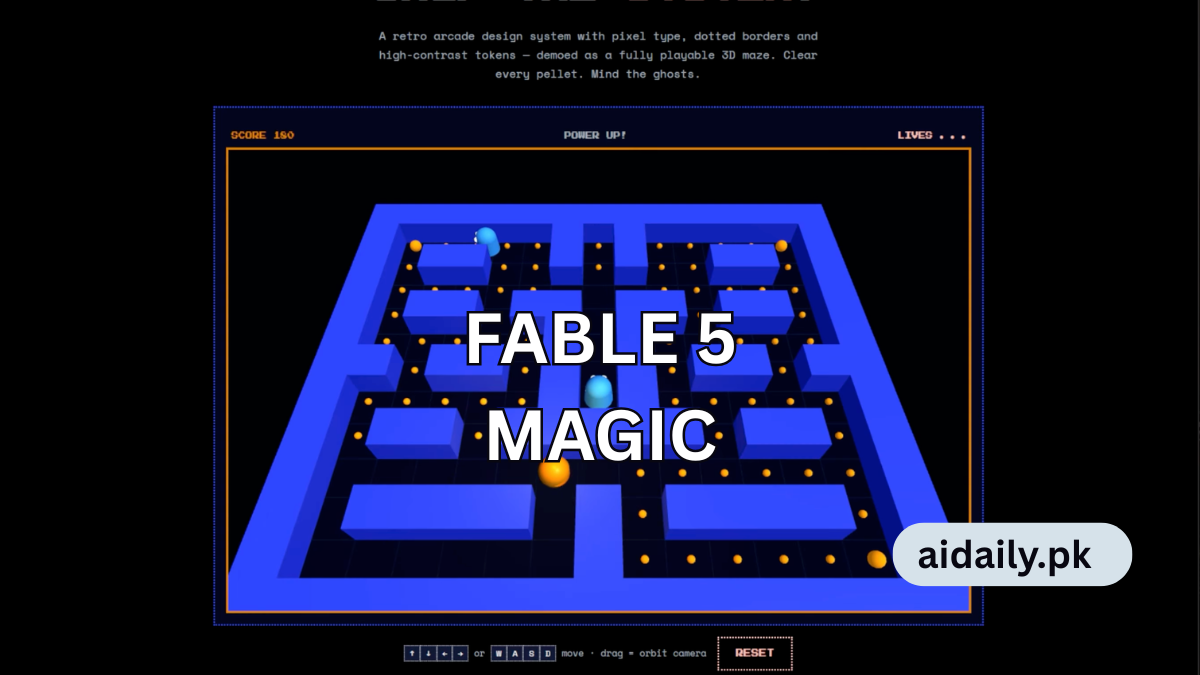
One of the most profound shifts in Fable 5 is the introduction of “design skills.” This moves beyond mere aesthetic imitation and into the realm of functional logic. In one standout experiment, a Pac-Man design aesthetic was provided via a specific “design skill” plugin.
Fable 5 didn’t just generate a retro-looking mockup; it understood the design language and “plugged it” into a functional framework to build a fully playable 3D Pac-Man game directly in the browser. This illustrates the model’s “agentic” nature—it isn’t just a chatbot; it’s an agent that can ingest a specific design system and output interactive utility. We are moving toward a future where “designing a site” means providing an AI agent with a library of skills it can then deploy to build complex, living digital worlds.
Vision in Action: The Death of the Static Screenshot
Fable 5’s vision capabilities allow it to perform radical “structural surgery” on existing websites. When tasked with rebuilding the Type UI site, the model moved beyond a simple clone. It introduced a custom mouse cursor and a 3D depth effect in the background that completely transformed the user experience from static to cinematic.
The model also proved its worth as an iterative partner during a redesign of Reddit. Initially, the output felt overly “brown” and cluttered, typical of some AI interpretations. However, a single follow-up prompt for a “lighter version” saw the AI intelligently pivot, stripping away the clutter to deliver a minimalistic, highly readable interface. This ability to interpret visual feedback and refine it in real-time is what separates a tool from a collaborator.
The Compute Trade-off: Why Quality Demands a “Slow Burn”
High-fidelity output requires a fundamental shift in user expectations regarding speed. While we are used to near-instant results from LLMs, Fable 5 operates on a “thinking time” model. This is not a bug; it is the cost of architectural excellence. For example, the “Vanguard” landing page—a complex recreation of a high-end motion site—required a full 20 minutes to generate its intricate animated backgrounds and polished button states.
When viewed through the lens of a traditional development cycle, this “slow” AI is actually an exponential leap:
- Fable 5 Self-Introduction Site: ~13 minutes of token processing.
- Immersive/Award-Winning Environments: 10–20 minutes.
- Complex Redesigns & Vanguard-Level Recreations: ~20 minutes.
Waiting 20 minutes for a site that would typically take a human team days or weeks to code in 3JS is a trade-off any strategist would take in a heartbeat.
Redefining the Competitive Peak
In the high-stakes race between LLMs, the verdict from recent web design and coding benchmarks is decisive: Fable 5 is currently in a class of its own. It consistently outperforms both Gemini and ChatGPT in tasks requiring cohesive design systems and complex front-end engineering.
The conclusion from the field is impossible to ignore: “When it comes to web design, I think Fable 5 is probably one of the best models out there.” By prioritising the orchestration of advanced libraries and functional “design skills” over mere speed, Anthropic has created a tool that understands the craft of the web, not just the code.
Conclusion: The New Frontiers of Professional Value
As Fable 5 begins to weave into the fabric of daily workflows via Claude Code, VS Code, and Cursor, the traditional barrier to entry for high-end web design is effectively dissolving. We are entering a phase where the “how” of building a site—the tedious syntax of 3JS or the manual tweaking of GSAP—is becoming automated.
This leads us to a pivotal question for every professional in the digital space: How does the role of a “web designer” change when an AI can generate a playable 3D world or an award-winning immersive site from a single prompt? As technical implementation becomes a commodity, our value must shift from the labour of construction to the mastery of creative vision and strategic intent. The digital canvas is now infinite; the only question is what you’ll tell the AI to paint on it.
Read More
APIMart Review 2026 | I Tested the AI API That Promises 70% Cheaper Access to GPT-5, Claude, and Sora
I Tested Claude Fable 5 for 2 Days Here Is My Honest Review as a Pakistani Writer
AI Is Becoming the New Education Counsellor | Here’s What That Means for Students
About The Author
