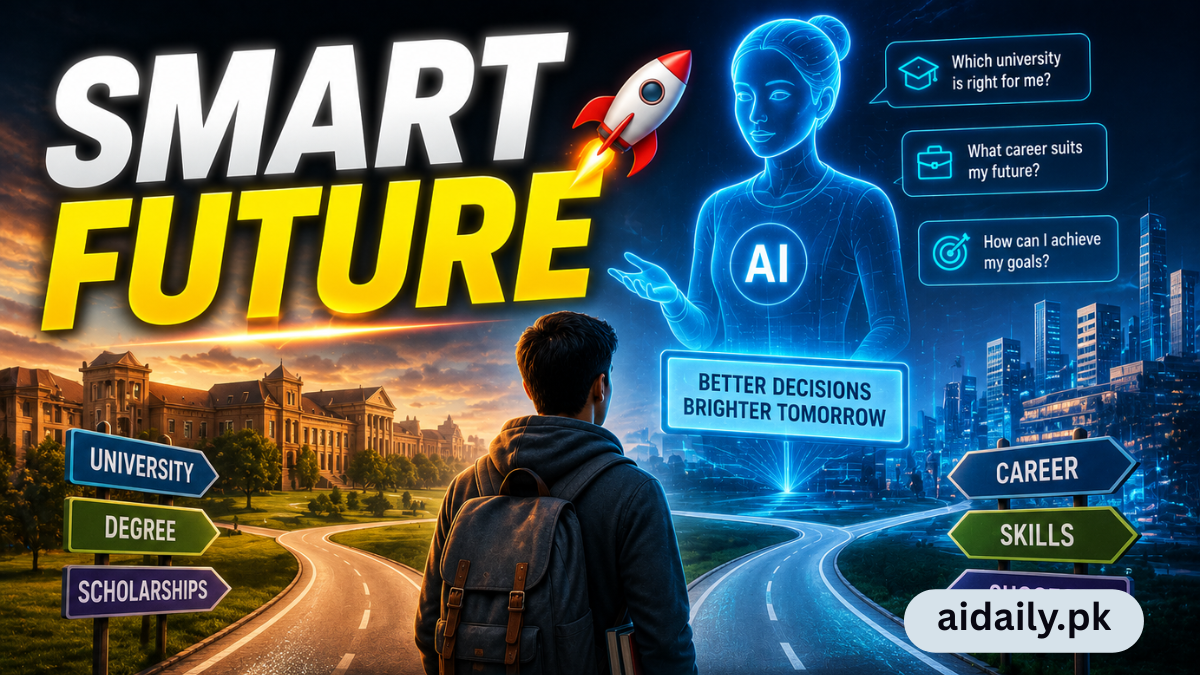
For decades, students relied on teachers, parents, friends, and education counsellors when making some of the biggest decisions of their lives.
Which university should I choose?
Which degree has the best career prospects?
Should I study Computer Science, Business, Engineering, or Medicine?
Today, a new advisor is entering that conversation:
Artificial Intelligence.
From ChatGPT and Gemini to Qwen and other advanced AI models, students are increasingly turning to AI tools for guidance on education, careers, admissions, and future opportunities.
The trend is growing rapidly around the world.
But is that a good thing?
And what does it mean for students in Pakistan?
The Information Overload Problem
Modern students face a challenge that previous generations never experienced.
Too much information.
A student researching universities today may encounter:
- Hundreds of university websites
- Thousands of YouTube videos
- Endless social media opinions
- Conflicting career advice
- Rankings that often disagree with each other
Instead of making decisions easier, the internet often creates confusion.
This is where AI is becoming useful.
Students can ask:
“Compare FAST, NUST, and COMSATS for Computer Science.”
Or:
“Which degree has better opportunities in Pakistan over the next five years?”
Instead of spending hours searching, students can get structured answers within seconds.
Why Students Are Turning to AI
The biggest advantage of AI is accessibility.
Traditional education counselling can be:
- Expensive
- Time-consuming
- Difficult to access outside major cities
AI tools are available 24/7.
A student in Karachi, Lahore, Peshawar, Quetta, or a small town can access the same technology instantly.
That changes the equation.
For many students, AI feels like having a personal advisor available whenever they need help.
Real-World Examples
Students are already using AI for:
University Selection
Comparing programs, tuition fees, scholarship opportunities, and career outcomes.
Career Planning
Exploring professions before committing to a degree.
Admission Guidance
Understanding application requirements and deadlines.
Study Planning
Creating revision schedules and learning roadmaps.
Scholarship Research
Finding opportunities that match their qualifications.
In many cases, AI helps students ask better questions rather than simply providing answers.
The Pakistan Opportunity
Pakistan has one of the youngest populations in the world.
Every year, millions of students make important academic decisions.
Many families cannot easily access professional counselling services.
This creates a major opportunity for AI-powered educational guidance.
Imagine a Pakistani student asking:
“I scored 82% in Intermediate. Which universities should I consider for Software Engineering?”
Or:
“Should I choose Accounting and Finance or Computer Science if I want remote job opportunities?”
AI can provide instant guidance based on available information.
For many families, that may be better than having no guidance at all.
The Benefits of AI Counselling
Faster Decisions
Students can compare multiple options in minutes.
Personalized Guidance
AI can tailor recommendations based on interests and goals.
Better Research
Students gain access to organised information instead of random internet searches.
Equal Access
Students from smaller cities can access the same tools as those in major urban centres.
Cost Savings
Many AI tools offer free versions.
The Risks Nobody Should Ignore
AI is powerful.
But it is not perfect.
Students should remember that AI can make mistakes.
It can:
- Present outdated information
- Misinterpret requirements
- Miss recent policy changes
- Oversimplify complex career decisions
Most importantly, AI cannot fully understand personal circumstances.
Choosing a university is not just about rankings.
It also involves:
- Financial realities
- Family considerations
- Personal interests
- Long-term goals
Those factors require human judgment.
Can AI Replace Human Education and Counsellors?
Not entirely.
At least not yet.
The best way to think about AI is as a research assistant rather than a replacement counsellor.
AI can help students:
✅ Gather information
✅ Compare options
✅ Understand opportunities
But final decisions still require human thinking.
An experienced counsellor can understand emotions, motivations, and life circumstances in ways AI currently cannot.
📩 Join AIDaily Brief
Get the biggest AI stories, tools, and insights from Pakistan and around the world — delivered every week.
Free newsletter. No spam. Only useful AI updates.
What the Future Could Look Like
The future may not be AI versus human counsellors.
It may be AI plus human counsellors.
Imagine a counsellor who uses AI to:
- Analyze student profiles
- Compare universities instantly
- Identify scholarship opportunities
- Generate personalised career plans
That combination could provide better guidance than either one alone.
Final Thoughts
AI is rapidly becoming one of the most influential educational tools available today.
For students, it offers faster access to information, greater flexibility, and personalised support that was previously unavailable to many people.
But students should be careful not to confuse guidance with certainty.
AI can help organise information.
It can help compare choices.
It can help explore opportunities.
What it cannot do is decide a student’s future.
The smartest students in the AI era will not blindly follow AI advice.
They will use AI to make more informed decisions while still relying on critical thinking, real-world experience, and human judgment.
In the end, AI may become an excellent education counsellor.
But the final decision will always belong to the student.
Read More
7 Ways Pakistani Freelancers Are Using ChatGPT to Earn More in 2026
ChatGPT Library Is Turning AI Chats Into a Personal Knowledge Vault
AI Startups for Pakistan | 7 Ideas That Could Build the Country’s Next Tech Giant
10 Free AI Tools Every Pakistani University Student Should Use in 2026
About The Author
