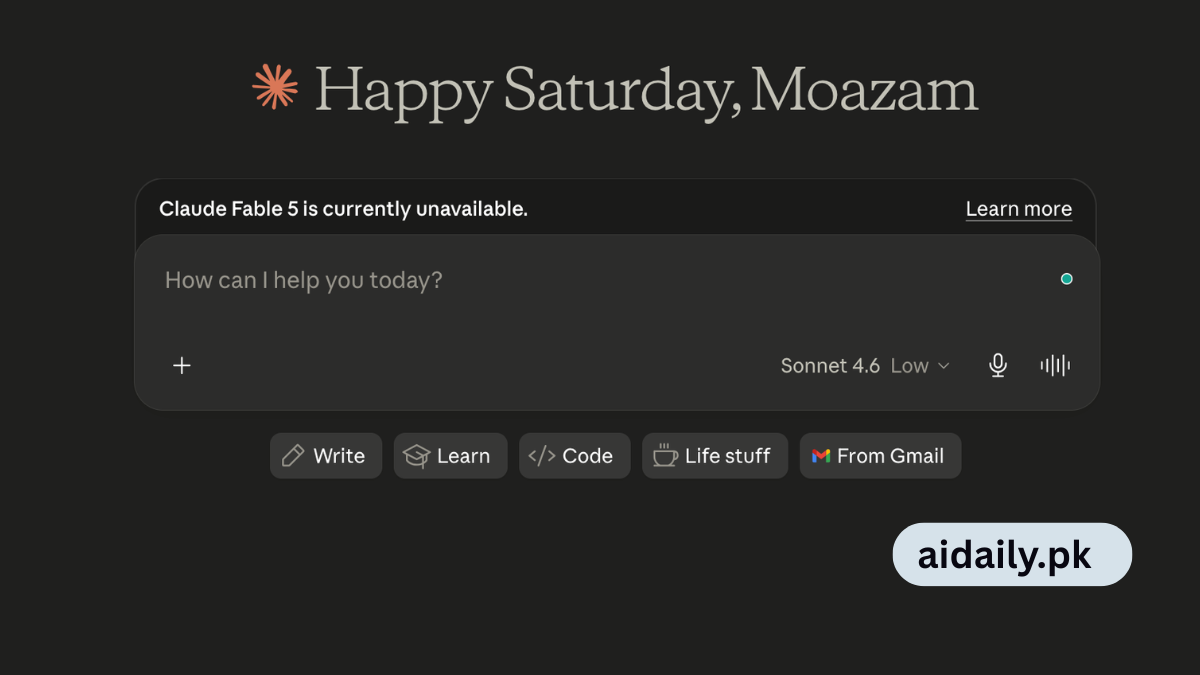
Claude Fable 5 Went Offline
Just three days ago, people were going crazy, saying Claude Fable 5 had completely changed the way we look at the world. They were acting like Claude Fable 5 could take hours of work and turn it into just one minute — building a website so good that even a regular developer might take seven days to create it.
But honestly, I was not one of those people jumping with excitement. I was thinking about the other side: such a powerful thing is now in the hands of an average person, and we don’t even know what kind of mindset that person has. Someone with the wrong intentions could use it to break high-level security in just a few minutes.
And then today, I opened Claude, and what did I see? “Claude Fable 5 is currently unavailable.” After that, I read the details — and then I understood what had actually happened.
What Happened?
Anthropic confirmed that it has suspended access to Claude Fable 5 and Claude Mythos 5 after receiving a U.S. government export-control directive. The order reportedly restricts access to these models by foreign nationals due to national security concerns. Rather than applying complex restrictions country by country, Anthropic temporarily disabled access altogether.
The decision came only days after Claude Fable 5 was introduced as a public-facing version of Anthropic’s powerful Mythos-class AI technology. The model was designed for advanced coding, research, and complex knowledge work.
Why This Matters
For years, governments focused on controlling AI chips and semiconductor exports.
Now the focus appears to be shifting toward controlling AI models themselves.
That is a major change.
If governments start restricting access to advanced AI systems, companies may face new licensing requirements, regional limitations, and compliance rules similar to those seen in the defence or aerospace industries.
The Bigger Question: Is AI the New Strategic Technology?
The shutdown suggests that advanced AI is no longer being viewed as just another software product.
According to reports, government concerns centred on the possibility that highly capable AI systems could help identify software vulnerabilities or assist sophisticated cyber operations. Anthropic disagreed with the government’s assessment but still complied with the order.
This creates an important question:
If AI models can influence cybersecurity, military planning, scientific research, and economic competitiveness, should governments regulate them the same way they regulate sensitive technologies?
Pakistan Angle
Pakistani freelancers were not really using it heavily anyway. Most of them probably didn’t even get the chance to use it properly, and now it has already been banned or made unavailable. Honestly, I don’t think Pakistani freelancers will be affected that much because they are probably getting the same kind of work done through ChatGPT 5.5.
Yes, there was hype around it, but it was not something that made people feel like their whole career was destroyed overnight. The reason is simple: Pakistani freelancers usually move more toward free or easily available tools. So in my opinion, even if it gets banned or becomes unavailable in Pakistan, most people here won’t be too worried. For them, the mindset will be: “No Claude? No problem. ChatGPT se kaam chala lo.”
Real Example
Imagine a Pakistani software house using Claude Fable 5 for code reviews, bug detection, and large-scale development projects.
If access suddenly disappears because of government regulations in another country, business operations could be disrupted overnight.
That is exactly why many enterprises now use multiple AI providers instead of relying on a single model.
The Claude Fable 5 situation is a reminder that AI access can become a geopolitical issue as much as a technical one.
Potential Risks and Challenges
Fragmented AI Access
Different countries may end up with different levels of access to advanced AI systems.
Regulatory Uncertainty
Developers and businesses may struggle to plan around changing government rules.
Innovation Slowdown
Strict restrictions could slow research and commercial adoption.
Security Concerns
Governments argue that unrestricted access to frontier AI could increase cyber risks and other national security threats.
📩 Join AIDaily Brief
Get the biggest AI stories, tools, and insights from Pakistan and around the world — delivered every week.
Free newsletter. No spam. Only useful AI updates.
My Take
The real issue is not just that Claude Fable 5 became unavailable. Think about the bigger picture: what if this kind of advanced AI model is in the hands of governments? Just imagine how they could use it, especially governments that already have control over CCTV cameras, surveillance systems, satellites, and military data. There were even recent reports and claims that AI tools were used in connection with attacks on Iran. Now imagine what else powerful countries could do with this technology. The country that reaches the next level in AI could become the next big global power. China is launching new AI tools almost every other day, but honestly, I still feel Claude’s real competitor is only OpenAI — nobody else is even close right now. Now think about AI inside military systems. The results could be extremely powerful because the government would have full control, and the system would work exactly according to their goals. While thinking about all this, I suddenly remembered Tom Cruise’s last movie, where AI had a dangerous role. The scary part is that was just a movie, but what if something like that is now standing right in front of us in real life?
Final Verdict
Claude Fable 5’s sudden suspension may be temporary, but the message is clear.
Advanced AI is no longer just a commercial product.
It is becoming a strategic asset.
As governments tighten control over frontier AI models, developers, businesses, and countries around the world may need to prepare for a future where access to cutting-edge AI is influenced as much by politics and national security as by technology itself.
FAQ
Why was Claude Fable 5 taken offline?
Anthropic says it suspended access after receiving a U.S. government export-control directive affecting Fable 5 and Mythos 5.
Is Claude Fable 5 permanently shut down?
No. Anthropic has indicated that the suspension is related to compliance with the directive and may not be permanent.
Why is this important for AI users?
The incident shows that access to advanced AI models can be affected by government policy, not just technical or business decisions.
What does this mean for Pakistan?
It highlights the risks of relying entirely on foreign AI providers and raises questions about long-term AI access and digital sovereignty.
Read More
Wanxiang Shengsheng’s AI Audiobook Tool Could Help Turn Thousands of Urdu Books Into Audiobooks
Moazam Opinion | The Free AI Era Ending — And That Should Concern Everyone
Thumblytics Review 2026 | Can This AI Tool Improve Your YouTube CTR?
AI Could Add Rs9.7 Trillion to Pakistan’s Economy by 2030 |But Is Pakistan Ready?
About The Author
