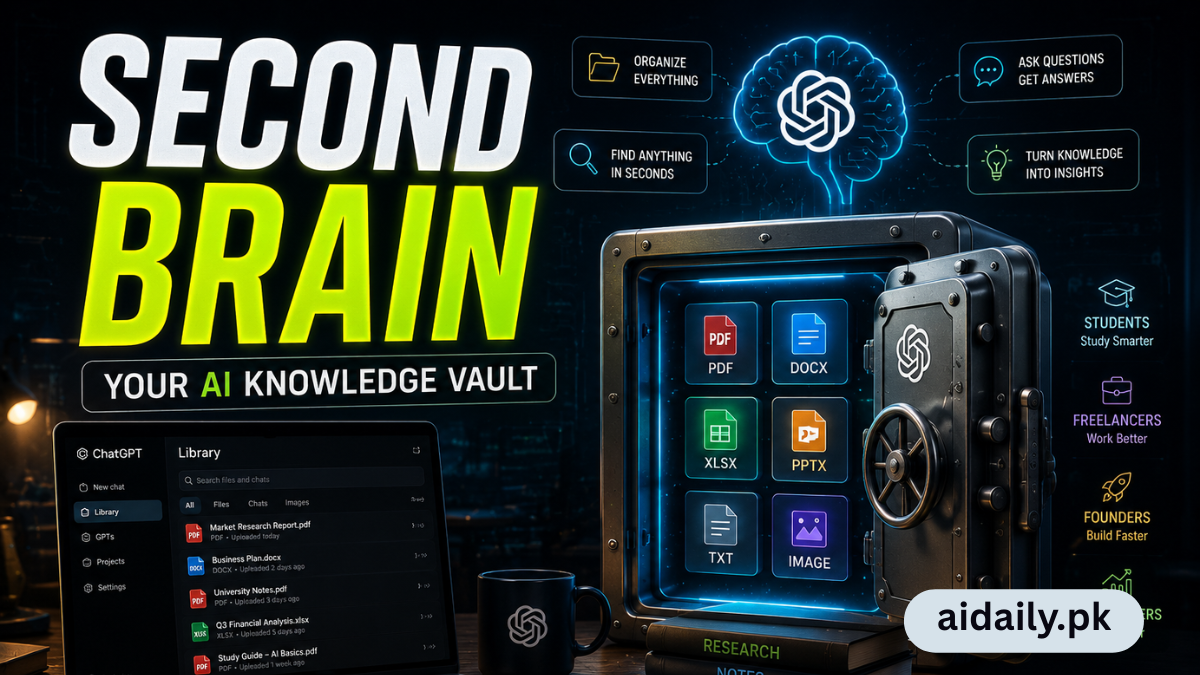
ChatGPT Library
For years, ChatGPT has been known as a chatbot. You ask a question. It answers.
The conversation ends.
But OpenAI appears to be moving toward something much bigger.
With the introduction of ChatGPT Library, the company is slowly transforming ChatGPT from a simple AI assistant into a personal knowledge vault — a place where your files, research, ideas, and work can live beyond a single conversation.
It may sound like a small feature update, but its long-term impact could be far more significant than many users realise.
What Is ChatGPT Library?
ChatGPT Library is a centralised space where users can access files they have uploaded or created inside ChatGPT.
Instead of searching through dozens of old conversations to find a PDF, spreadsheet, image, or report, users can view their saved files from one location.
At first glance, this looks like a simple organisational feature.
In reality, it represents something much bigger.
It signals OpenAI’s intention to make ChatGPT a long-term workspace rather than a temporary chat tool.
The Problem OpenAI Is Trying to Solve
Most active ChatGPT users face the same issue.
After a few months of usage, conversations start piling up.
Research documents become difficult to find.
Important files disappear inside old chats.
Business plans get buried.
University notes become scattered across multiple conversations.
Many users eventually spend more time searching for information than actually using it.
ChatGPT Library attempts to solve that problem.
Instead of treating every conversation as an isolated session, the platform now provides a way to keep important work accessible.
Why This Matters More Than It Seems
The biggest AI trend of the next few years may not be smarter answers.
It may be better memory.
Most AI tools today are excellent at generating information.
But humans don’t just need information.
They need organisation.
Imagine a university student who uploads:
- Lecture notes
- Research papers
- Class presentations
- Assignment drafts
Instead of storing those files across dozens of conversations, everything can be kept inside a single AI-powered workspace.
The same applies to freelancers, startup founders, researchers, and professionals.
The value isn’t just the AI.
The value is having your knowledge organised in one place.
ChatGPT Is Starting to Look Like a Second Brain
The concept of a “second brain” has become increasingly popular among productivity enthusiasts.
A second brain is a digital system that stores information, ideas, notes, and knowledge so you don’t have to remember everything yourself.
Traditionally, people used tools such as:
- Notion
- Evernote
- Obsidian
- Google Drive
Now OpenAI appears to be pushing ChatGPT into that category.
The difference is that ChatGPT doesn’t just store information.
It can interact with it.
You can upload documents and ask questions.
You can summarise reports.
You can extract insights.
You can generate new ideas based on old files.
That changes the relationship between users and their information.
What This Means for Students
Students may be among the biggest winners.
Imagine uploading:
- Entire course notes
- Semester presentations
- Research materials
- Assignment drafts
Then asking ChatGPT:
“What topics appear most frequently in my notes?”
“Create revision questions from these documents.”
“Summarise all of my lecture slides.”
This turns static files into interactive study material.
For many students, ChatGPT Library could become a personal academic workspace.
What This Means for Freelancers and Founders
The benefits extend beyond education.
Freelancers can store:
- Client proposals
- Contracts
- Research files
- Content drafts
Startup founders can organise:
- Business plans
- Product ideas
- Market research
- Investor documents
Instead of repeatedly uploading the same files, users can maintain a growing knowledge base inside ChatGPT.
This saves time and improves productivity.
The Potential Downsides
While the feature is promising, there are important questions.
Privacy
As users upload more documents, privacy becomes increasingly important.
Many people will want clear controls over what is stored and how that information is used.
Information Overload
A large library can quickly become messy.
Without strong search and organisation features, users may face the same problems they already experience with email and cloud storage.
Platform Dependence
The more information users place inside a single ecosystem, the more dependent they become on that platform.
That raises questions about portability and long-term access.
The Bigger Picture
The launch of ChatGPT Library reveals something important about OpenAI’s strategy.
The company is no longer focused solely on making ChatGPT smarter.
It is trying to make ChatGPT more useful.
There is a major difference.
The future AI battle may not be won by the model with the highest benchmark score.
It may be won by the platform that becomes the centre of a user’s digital life.
If that happens, ChatGPT will no longer be just a chatbot.
It will become a workspace.
A research assistant.
A document manager.
A study partner.
And perhaps most importantly, a personal knowledge vault.
📩 Join AIDaily Brief
Get the biggest AI stories, tools, and insights from Pakistan and around the world — delivered every week.
Free newsletter. No spam. Only useful AI updates.
Final Thoughts
ChatGPT Library may seem like a simple feature on the surface.
But it points toward a much larger shift.
AI is moving beyond answering questions.
It is beginning to organise, manage, and interact with the information that matters most to us.
For students, freelancers, entrepreneurs, and professionals, that could be one of the most important developments in AI this year.
The real story isn’t that ChatGPT now has a Library.
The real story is that OpenAI is slowly turning ChatGPT into a second brain.
Read More
AI Startups for Pakistan | 7 Ideas That Could Build the Country’s Next Tech Giant
10 Free AI Tools Every Pakistani University Student Should Use in 2026
Claude Fable 5: Anthropic’s Most Powerful AI Yet | But Users Are Already Angry Over Limits
About The Author
