Quick Summary
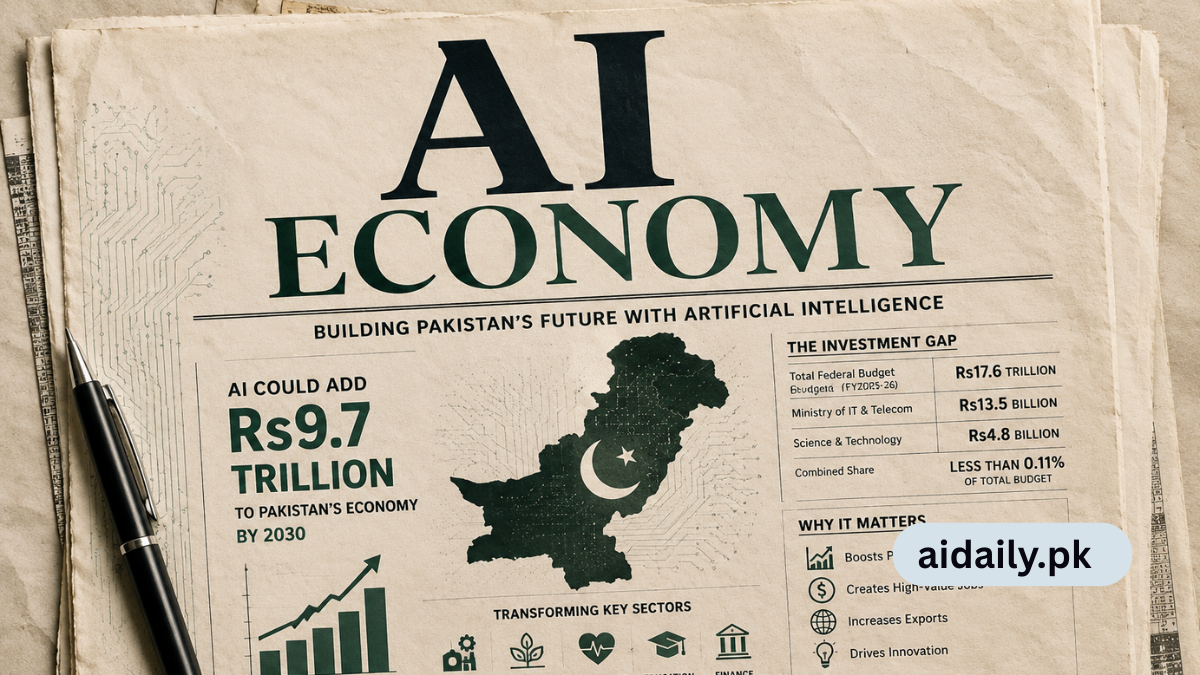
Artificial Intelligence (AI) could contribute as much as Rs9.7 trillion to Pakistan’s economy by 2030, according to digital transformation estimates. The opportunity is enormous, spanning manufacturing, agriculture, healthcare, finance, education, and exports.
However, while the economic potential is massive, Pakistan still faces major challenges in AI skills, funding, certifications, and business adoption. The question is no longer whether AI will reshape the economy—it is whether Pakistan can move fast enough to benefit from it.
What Happened?
A growing body of research suggests that AI and digital transformation could generate up to Rs9.7 trillion in economic value for Pakistan by 2030. At the same time, studies indicate that closing Pakistan’s digital skills gap could add another Rs2.8 trillion to annual GDP over the coming years.
The numbers are attracting attention because Pakistan’s technology sector is already expanding rapidly. IT exports reached approximately $3.39 billion during the first nine months of FY2025-26, putting the industry on track for a record year. Yet despite this growth, AI adoption remains relatively limited outside major technology companies.
The opportunity is clear. The challenge is execution.
Why It Matters?
AI is often discussed as a technology trend, but its real impact is economic.
When businesses use AI effectively, they can:
- Automate repetitive work
- Reduce operational costs
- Improve customer service
- Increase productivity
- Make faster business decisions
- Develop new products and services
Historically, countries that adopted transformative technologies early gained major economic advantages. Electricity, computers, and the internet all followed this pattern.
AI may become the next major productivity revolution.
If Pakistan successfully adopts AI across industries, the benefits could extend far beyond the technology sector.
Pakistan Angle
Pakistan has several advantages that many countries would envy.
A Young Population
More than half of Pakistan’s population is under 30. This creates a large pool of future workers capable of learning and adopting AI technologies.
A Growing IT Industry
Pakistan now produces over 75,000 IT graduates every year and continues to expand its software exports. The country is also one of the world’s leading freelancing markets.
Competitive Costs
Pakistani developers, agencies, and startups can often deliver services at significantly lower costs than firms in Western markets.
However, these strengths alone are not enough.
Pakistan still struggles with:
- Limited AI funding
- Lack of recognised AI certifications
- Skills mismatch between universities and industry
- Low AI adoption among SMEs
- Insufficient research infrastructure
Is Pakistan Investing Enough?
This is where the debate becomes more interesting.
Pakistan’s FY2025-26 federal budget totals approximately Rs17.6 trillion.
Yet:
| Sector | Budget Allocation |
|---|---|
| Ministry of IT & Telecom | Rs13.5 Billion |
| Science & Technology | Rs4.8 Billion |
| Combined Share | Less than 0.11% of the total budget |
These figures raise an important question:
Can Pakistan realistically become a major AI economy while allocating such a small portion of national spending toward technology and innovation?
Many experts argue that ambition and investment are currently moving at different speeds.
Real Example: What Rs9.7 Trillion Actually Looks Like
Large economic figures can feel abstract.
Consider a textile factory in Faisalabad.
AI systems could:
- Predict machine failures before they happen
- Reduce energy consumption
- Improve quality control
- Minimise production waste
Now multiply similar improvements across:
- Agriculture
- Healthcare
- Retail
- Logistics
- Banking
- Manufacturing
The cumulative impact becomes significant.
AI does not create value through a single breakthrough.
It creates value through thousands of small efficiency improvements happening simultaneously across the economy.
Why Pakistan Could Win
Despite current challenges, Pakistan has some unique opportunities.
GCC Demand Is Rising
The Gulf region spends billions of dollars annually on AI consulting and implementation services. Pakistan currently captures only a tiny share of that market.
Freelancers Are Adopting AI Quickly
Many Pakistani freelancers are already using AI tools for content creation, coding, design, marketing, and customer support.
Startups Can Move Faster
Unlike older economies burdened by legacy systems, Pakistani startups can build AI-first businesses from day one.
What Could Go Wrong?
Many AI discussions focus only on opportunities.
The risks deserve equal attention.
1. Skills Gap Persists
Pakistan produces graduates, but many lack practical AI experience.
2. Brain Drain Accelerates
Highly skilled AI professionals may continue leaving for better opportunities abroad.
3. SMEs Ignore AI
If small and medium-sized businesses fail to adopt AI, much of the projected economic value may never materialise.
4. Policy Stays on Paper
Strong AI strategies mean little without funding, execution, and accountability.
5. Global Competition Intensifies
Countries such as India, the UAE, and Saudi Arabia are investing aggressively in AI talent and infrastructure.
Pakistan cannot afford to move slowly.
📩 Join AIDaily Brief
Get the biggest AI stories, tools, and insights from Pakistan and around the world — delivered every week.
Free newsletter. No spam. Only useful AI updates.
My Take
Mere hisaab se Pakistan ka AI future talent par depend nahi karta.
Talent already maujood hai.
Asal challenge execution ka hai.
Pakistan har saal hazaron IT graduates produce karta hai. Freelancing ecosystem bhi strong hai. Software exports bhi record levels par hain. Lekin AI economy sirf talent se build nahi hoti. Us ke liye skills, certifications, infrastructure, investment, aur business adoption ki zaroorat hoti hai.
Maine personally notice kiya hai ke AI conversation Pakistan mein aksar ChatGPT tak limited rehti hai. Jab ke asal opportunity factories, hospitals, banks, logistics companies, aur SMEs mein AI adoption se aayegi.
Agar Pakistan agar 5 saal mein AI skills development aur business adoption par serious focus karta hai, to Rs9.7 trillion ka target ambitious zaroor hai, lekin impossible nahi.
Final Verdict
Pakistan may not have the biggest AI budget in the region, but it has one of the youngest populations and fastest-growing digital workforces.
The next decade will determine whether AI becomes Pakistan’s economic accelerator—or another missed opportunity.
FAQ
How much could AI add to Pakistan’s economy by 2030?
Digital transformation estimates suggest AI and related technologies could generate up to Rs9.7 trillion in economic value by 2030.
Does Pakistan have enough AI talent?
Pakistan has a large pool of IT graduates, but there is still a significant shortage of professionals with applied AI skills.
Which industries could benefit most from AI?
Manufacturing, agriculture, healthcare, logistics, banking, retail, and customer service are among the sectors expected to benefit the most.
Why is AI adoption important for SMEs?
Small and medium-sized businesses make up a large part of Pakistan’s economy. AI can help them reduce costs, improve efficiency, and compete globally.
What is Pakistan’s biggest AI challenge?
Many experts believe the biggest challenge is not talent, but execution—turning AI potential into real economic outcomes.
Read More
Pakistan Is Producing 75,000 IT Graduates a Year | So Why Are AI Jobs Still Going Unfilled?
Claude Fable 5 | Anthropic’s Most Powerful AI Yet | But Is the Hype Justified?
Beyond the Pixels | Why Fable 5 is the New Gold Standard for Generative Web Design
About The Author
