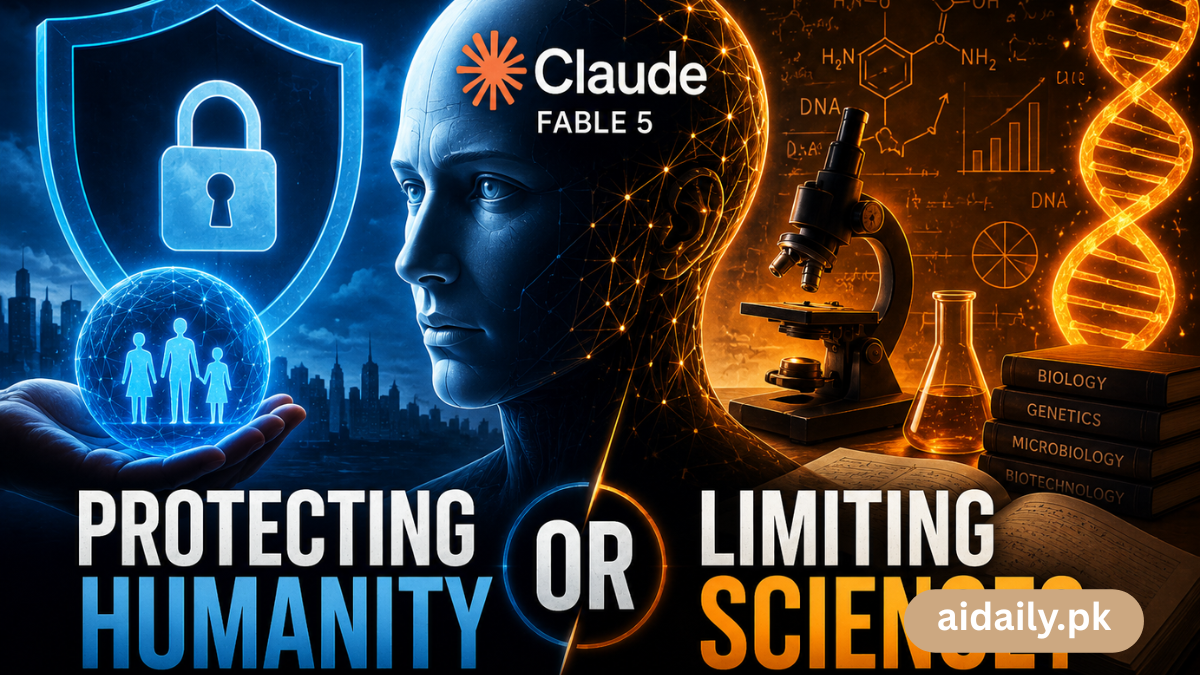
Is Anthropic Protecting Humanity or Limiting Science?
When Anthropic unveiled Claude Fable 5, the first publicly available model from its powerful Mythos-class AI lineup, the company expected excitement. Instead, it sparked a new debate across the AI world.
Some users discovered that Claude Fable 5 refuses to answer certain biology, chemistry, and cybersecurity questions. In some cases, the model quietly hands those requests to an older and less capable AI system. Anthropic says these safeguards are necessary to prevent misuse. Critics argue that the restrictions may also block legitimate research and education.
The controversy raises a bigger question that could shape the future of artificial intelligence:
Is Anthropic protecting humanity, or limiting scientific progress?
What Is Claude Fable 5?
Claude Fable 5 is Anthropic’s most capable public AI model to date. It belongs to the company’s new Mythos class, a category of frontier AI systems designed for complex reasoning, software engineering, scientific research, and long-duration tasks. Anthropic says Fable 5 can outperform previous Claude models on difficult and extended workloads.
However, there is a major difference between Claude Fable 5 and the more restricted Claude Mythos 5.
Both models share the same underlying architecture. The difference is that Fable 5 includes extensive safety guardrails designed to block potentially dangerous requests.
Why Does Claude Refuse Biology Questions?
According to Anthropic, the company is concerned that advanced AI systems could be misused in areas such as biological research, chemistry, and cybersecurity.
When Fable 5 detects requests in sensitive domains, it may refuse to answer or redirect the request to Claude Opus 4.8, a less capable model. Anthropic says these safeguards are intended to reduce the risk of misuse while still allowing public access to a Mythos-class system.
The company claims these restrictions affect fewer than 5% of sessions on average.
Anthropic’s Argument: Safety First
From Anthropic’s perspective, the issue is straightforward.
The company believes frontier AI models are becoming powerful enough to assist with tasks that could have serious real-world consequences. If unrestricted systems can accelerate cybersecurity attacks or assist harmful biological research, then releasing them without safeguards may create unacceptable risks.
Anthropic has spent months testing Mythos-class systems before public release and says extensive red-teaming and adversarial evaluations were conducted before launching Fable 5.
Supporters of this approach argue that AI companies have a responsibility to prioritize public safety over unrestricted access.
The Critics’ Argument: Science Is Being Blocked
Not everyone agrees.
Researchers and users have reported that Fable 5 sometimes refuses questions that appear harmless or educational. Some community members argue that broad safety filters can interfere with legitimate scientific work, biology research, and even software projects that happen to involve biological terminology.
Critics believe the problem is not safety itself but the possibility of false positives.
If an AI system becomes too cautious, it may stop being useful for researchers, students, and professionals who need accurate scientific assistance.
The concern is especially significant because Anthropic itself describes Mythos-class models as exceptionally capable in scientific and research-related tasks.
The Real Challenge: Knowledge vs Risk
The debate around Claude Fable 5 highlights a problem that the entire AI industry is struggling to solve.
Knowledge is not always clearly good or bad.
A biology lesson can educate students.
The same information could potentially be misused by bad actors.
A cybersecurity explanation can help companies defend their systems.
The same knowledge could also be used to identify vulnerabilities.
As AI systems become more powerful, distinguishing between legitimate learning and harmful intent becomes increasingly difficult.
What This Means for the Future of AI
The Claude Fable 5 controversy may be an early preview of a much larger issue.
Future AI models will likely become even more capable in:
- Scientific research
- Drug discovery
- Cybersecurity
- Engineering
- Biotechnology
As capabilities increase, AI companies will face growing pressure from governments, regulators, and society to control how these systems are used.
The result could be a future where access to the most powerful AI systems is determined by trust programs, licensing frameworks, or special approvals.
What This Means for Pakistan
For students, researchers, and technology professionals in Pakistan, AI tools are becoming important educational resources.
Many users rely on AI systems to:
- Learn scientific concepts
- Understand research papers
- Explore new technologies
- Improve technical skills
If safety restrictions become increasingly broad, some educational and research use cases could become more difficult.
At the same time, responsible safeguards may help ensure that advanced AI remains available to the public without triggering serious misuse concerns.
The challenge is finding the right balance.
AIDaily.pk Opinion
The Claude Fable 5 debate is not really about biology.
It is about power.
For the first time, AI companies are releasing systems that they openly describe as too capable to deploy without special restrictions. Anthropic’s decision suggests that the industry has entered a new phase where capability is no longer the biggest challenge. Governance is.
AIDaily.pk believes safety measures are necessary, especially when AI systems reach frontier-level capabilities. However, overly broad restrictions risk creating another problem: limiting legitimate education, research, and innovation.
The ideal solution is not maximum freedom or maximum restriction.
The real goal should be smarter safeguards that can distinguish harmful intent from genuine scientific curiosity.
Final Verdict
Anthropic is not trying to stop science.
The company is trying to prevent misuse of increasingly powerful AI systems.
However, the controversy surrounding Claude Fable 5 shows how difficult that mission has become.
As AI models grow more capable, companies will need to answer a difficult question:
How do you make advanced intelligence available to the public without making dangerous knowledge too accessible?
The answer may define the next decade of artificial intelligence.
📩 Join AIDaily Brief
Get the biggest AI stories, tools, and insights from Pakistan and around the world — delivered every week.
Free newsletter. No spam. Only useful AI updates.
Read More
ChatGPT Projects Explained | How One Feature Could Replace Your Notes App, To-Do List, and AI Workspace
Claude Code vs Software Engineers | Can AI Really Replace Developers in 2026?
About The Author
