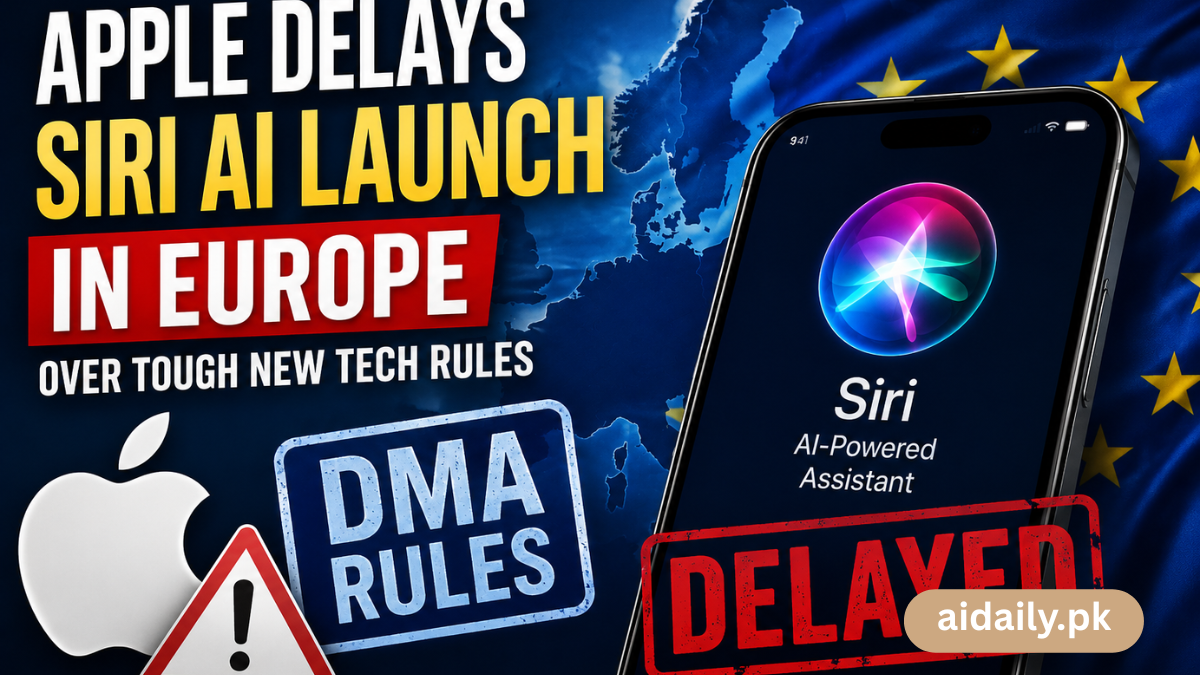
Apple’s ambitious plan to bring advanced AI-powered Siri features to iPhone users has hit a major obstacle in Europe.
The company has reportedly delayed the rollout of its next-generation Siri experience for users in the European Union due to concerns surrounding the region’s strict Digital Markets Act (DMA) regulations.
The move highlights a growing conflict between major technology companies and regulators as governments around the world attempt to establish rules for artificial intelligence and digital platforms.
While Apple continues expanding its AI strategy in other markets, European users may have to wait longer to experience some of the company’s most advanced AI features.
Why Is Apple Delaying Siri AI in Europe?
At the centre of the issue is the European Union’s Digital Markets Act (DMA), a landmark regulation designed to increase competition and reduce the dominance of large technology platforms.
The law requires major technology companies to make their ecosystems more open and interoperable with competing services.
Apple has expressed concerns that some of the DMA requirements could create challenges related to privacy, security, and the integration of advanced AI features.
As a result, the company appears to be taking a more cautious approach before launching certain AI capabilities across EU markets.
Apple’s Growing AI Ambitions
The delayed Siri rollout comes at a critical moment for Apple.
The company has been working to modernise Siri after years of criticism that the assistant lagged behind competitors such as ChatGPT, Gemini, and Claude.
Recent beta versions of Apple’s software have showcased a significantly smarter Siri capable of handling more natural conversations, understanding context, and performing complex tasks across apps.
These improvements are seen as a key part of Apple’s broader artificial intelligence strategy.
For Apple, Siri is no longer just a voice assistant. It is becoming the central AI interface across the iPhone ecosystem.
Europe’s Tough Stance on Big Tech
The European Union has become one of the world’s most aggressive regulators of large technology companies.
In recent years, regulators have introduced new rules covering privacy, competition, app stores, digital advertising, and artificial intelligence.
Supporters argue that these regulations help protect consumers and prevent anti-competitive behavior.
Critics, however, claim that excessive regulation could slow innovation and delay access to new technologies for European users.
The Siri delay is already being cited as an example of how stricter rules can impact the rollout of cutting-edge AI products.
What It Means for iPhone Users
For users outside Europe, Apple’s AI plans are expected to continue moving forward.
European iPhone owners, however, could face delays in receiving some of the company’s newest AI-powered experiences.
This creates an unusual situation where users in different regions may receive significantly different versions of Apple’s software capabilities.
As AI becomes an increasingly important part of smartphones, access to advanced features could become a major competitive factor in the global technology market.
Apple vs Europe: A Bigger Battle
The dispute is about more than Siri.
It represents a broader struggle between technology companies seeking to innovate quickly and regulators attempting to ensure fairness, transparency, and consumer protection.
As AI becomes more powerful and integrated into everyday devices, similar conflicts are likely to emerge across multiple markets.
The outcome of these battles could influence not only how AI products are developed, but also how quickly consumers gain access to them.
The Bottom Line
Apple’s decision to delay advanced Siri AI features in Europe demonstrates how regulation is becoming a major factor in the global AI race.
While the company works to navigate the EU’s Digital Markets Act, European users may have to wait longer for Apple’s most ambitious AI upgrades.
The situation highlights a growing question facing the technology industry: how can governments regulate powerful AI systems without slowing innovation?
The answer may shape the future of artificial intelligence for years to come.
Read More
After Years of Falling Behind, Siri May Finally Be Ready for the AI Era
Ant Group’s AMP Protocol Could Let AI Agents Pay, Trade, and Work Across Borders
AI Companies Are Hiring Liberal Arts Graduates at High Salarie
About The Author
