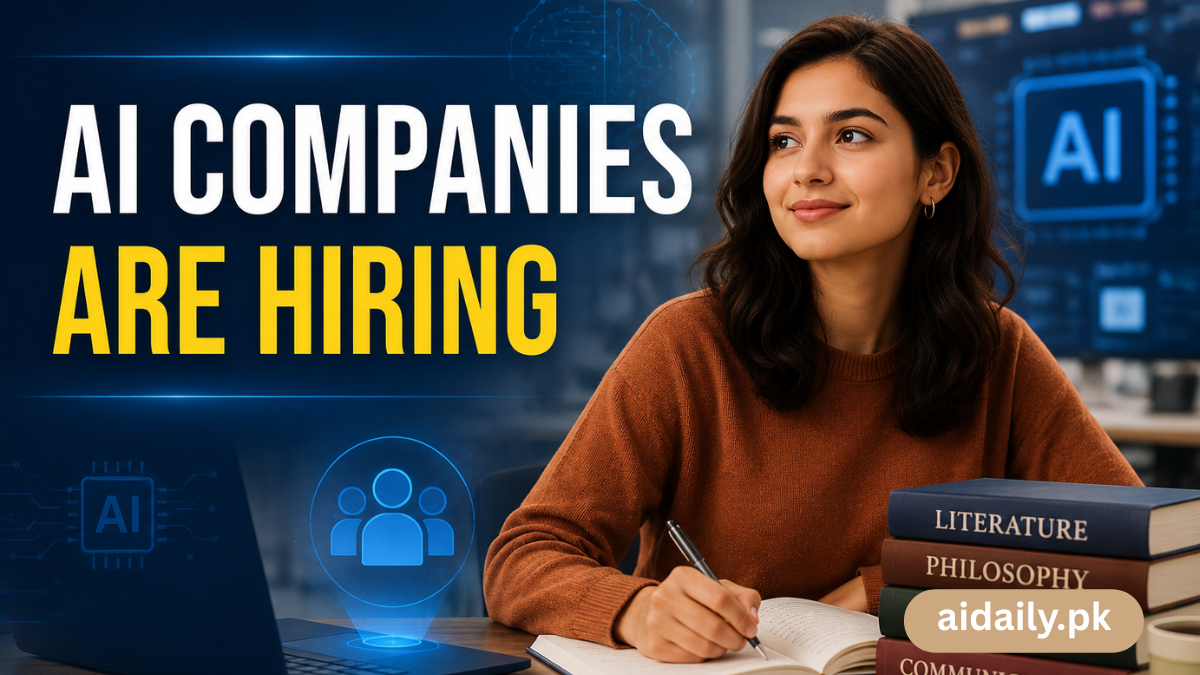
For years, students around the world have heard the same message: if you want a high-paying career, study engineering, computer science, or another technical field. Degrees in literature, philosophy, history, sociology, and communication were often viewed as less valuable in the job market.
However, the rise of artificial intelligence is beginning to challenge that belief.
According to recent reports, several leading AI companies are actively competing to hire liberal arts graduates, with some positions offering monthly salaries of up to 30,000 yuan. The trend suggests that the AI industry is no longer looking only for programmers and engineers. Instead, companies are increasingly searching for people who can understand language, human behavior, communication, culture, and critical thinking.
The development could have significant implications not only for global job markets but also for students and professionals in Pakistan.
Why AI Companies Need Liberal Arts Graduates
At first glance, it may seem surprising that AI firms are recruiting people from non-technical backgrounds. After all, artificial intelligence is built using complex algorithms, software, and computing infrastructure.
Yet modern AI systems are fundamentally designed to interact with humans.
Large language models must understand context, communication styles, cultural differences, emotions, reasoning patterns, and ethical concerns. These areas often fall within the expertise of people who have studied humanities and social sciences.
As AI products become more advanced, companies need specialists who can help improve model responses, evaluate outputs, create training data, conduct research, and understand how people actually communicate.
In many cases, these tasks require strong analytical and language skills rather than advanced programming knowledge.
The Rise of New AI Careers
The AI boom is creating entirely new job categories that barely existed a few years ago.
Many companies now hire professionals for roles such as:
- AI Content Specialist
- AI Research Analyst
- Prompt Engineer
- Data Annotation Expert
- AI Ethics Researcher
- Conversation Designer
- Human Feedback Evaluator
- Localization Specialist
These positions often involve teaching AI systems how humans think, write, communicate, and solve problems.
For this reason, graduates from fields such as English, Journalism, Psychology, Sociology, Philosophy, and Communication Studies are becoming increasingly valuable.
The Salary Numbers Turning Heads
One of the biggest reasons this trend is attracting attention is the level of compensation being offered.
According to reports, some leading AI companies in China are offering monthly salaries ranging from 25,000 to 30,000 yuan for certain AI-related positions. In some cases, compensation packages for top candidates can go even higher.
These roles are not limited to software engineering. Companies are increasingly hiring professionals with backgrounds in literature, philosophy, communication, sociology, journalism, and other liberal arts disciplines to help train, evaluate, and improve AI systems.
The trend highlights a growing reality in the AI industry: understanding human language, behavior, and reasoning is becoming almost as important as understanding code.
For students and graduates around the world, including Pakistan, the development suggests that strong communication, research, and critical-thinking skills may become increasingly valuable in the age of artificial intelligence.
A Major Shift in the Global Job Market
The hiring trend reflects a broader transformation in the technology industry.
In the past, technology companies primarily focused on technical expertise. Today, the success of an AI product depends not only on its technical capabilities but also on its ability to communicate effectively with users.
As competition intensifies among AI firms, the demand for professionals who understand human language and behavior is growing rapidly.
This shift demonstrates that the future workforce may not be divided between “technical” and “non-technical” careers. Instead, employers are increasingly looking for individuals who can combine domain knowledge, communication skills, and critical thinking with AI tools.
What This Means for Pakistan
The trend is particularly important for Pakistan, where many students still believe that only engineering or computer science degrees can lead to successful careers.
Pakistan produces thousands of graduates every year in subjects such as English Literature, Mass Communication, International Relations, Psychology, and Education. Many of these graduates face limited career opportunities compared to their technical counterparts.
The rapid expansion of the AI industry could begin changing that reality.
As global companies continue investing in AI development, demand for language experts, researchers, content specialists, and AI trainers is expected to increase. Pakistani graduates with strong English skills and analytical abilities may find new opportunities in remote work, freelancing, and international AI projects.
The country already has a large freelance workforce. If students learn how to work with AI systems and develop skills in research, writing, critical thinking, and prompt design, they could become competitive candidates for emerging AI-related roles.
The Skills That May Matter Most in the AI Era
The latest hiring trend sends an important message: technical skills remain valuable, but they are no longer the only path to success.
In the AI era, employers are increasingly looking for people who can:
- Communicate clearly
- Analyze information critically
- Understand human behavior
- Solve complex problems
- Evaluate AI-generated content
- Work effectively with AI tools
These abilities are often developed through liberal arts education and may become even more valuable as artificial intelligence becomes a bigger part of everyday work.
The Bottom Line
The idea that liberal arts degrees are “useless” is being challenged by one of the fastest-growing industries in the world.
As AI companies invest heavily in building smarter and more human-centered products, they are discovering that understanding people can be just as important as understanding code.
For students in Pakistan and around the world, the message is clear: the future of work may belong not only to those who build AI, but also to those who teach it how humans think, communicate, and create.
Read More
Kimi Code’s New Upgrade Could Change How Developers Worldwide Including Pakistan Build Software
About The Author
