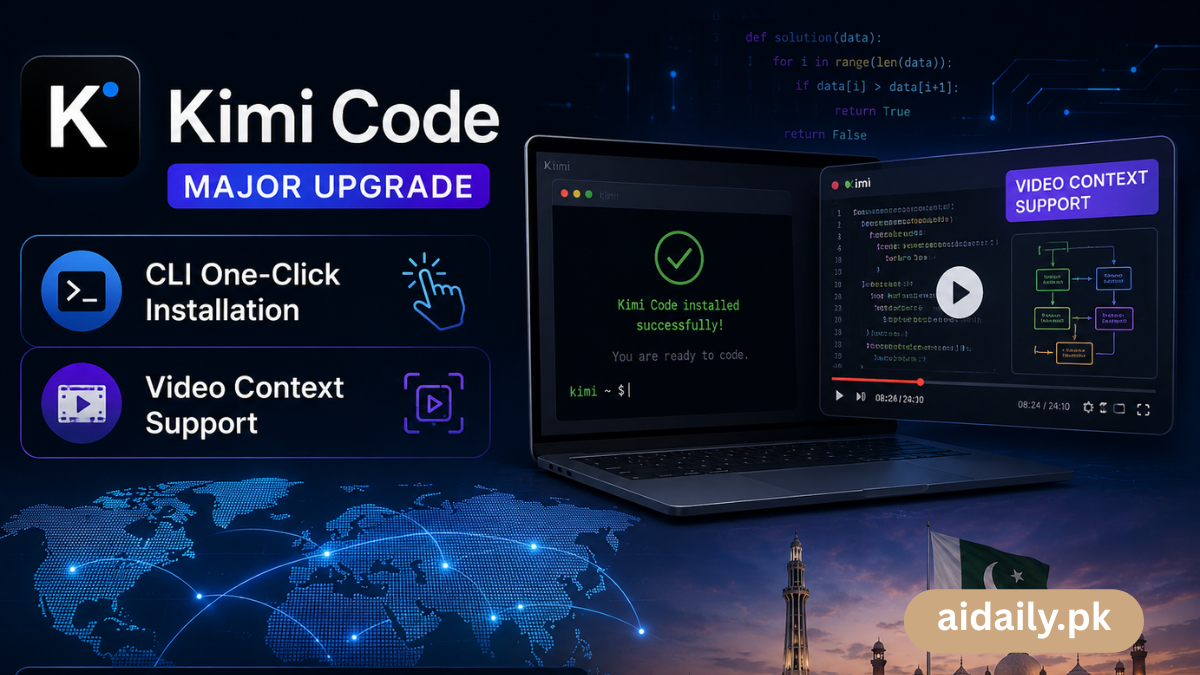
The race to build smarter AI coding assistants is accelerating, and Kimi Code has just taken a significant step forward. The open-source coding agent recently received a major upgrade that introduces two highly requested capabilities: one-click CLI installation and video context support.
While the update may appear technical at first glance, its implications extend far beyond convenience. From global software teams to Pakistan’s growing community of developers and freelancers, the new features could make AI-powered coding tools more accessible and practical than ever before.
What Is New in Kimi Code?
The latest release focuses on reducing setup complexity while expanding the type of information the AI can understand.
The introduction of one-click CLI installation allows developers to get started quickly without spending time configuring complex environments. This lowers the barrier to entry, especially for students, beginners, and teams that want to deploy the tool across multiple systems.
The second major addition is video context support. Instead of relying only on text prompts, documentation, or code snippets, developers can now provide video-based context. This opens new possibilities for understanding tutorials, debugging walkthroughs, product demonstrations, and technical explanations delivered through video.
Why Video Context Matters
Software development is increasingly driven by video content. Developers learn from YouTube tutorials, conference presentations, online courses, and screen-recorded bug reports.
Traditional AI coding assistants can only analyze text-based information. By adding video understanding capabilities, Kimi Code moves closer to a multimodal development workflow where the AI can process both visual and textual information.
This could help developers extract insights from lengthy technical videos, understand implementation examples faster, and receive coding assistance based on visual demonstrations rather than manually written notes.
Global Impact on the AI Coding Race
The AI coding assistant market has become one of the most competitive segments in artificial intelligence.
Companies behind tools such as GitHub Copilot, Cursor, Claude-powered coding solutions, and OpenAI’s developer products are all working to improve developer productivity. Kimi Code’s latest update demonstrates how open-source projects are continuing to innovate alongside commercial offerings.
The addition of easier installation and multimodal capabilities reflects a broader industry trend: AI coding agents are evolving from simple code completion tools into intelligent software development assistants capable of understanding multiple forms of input.
What This Means for Pakistan’s Developers
Pakistan’s technology sector has experienced steady growth in recent years, supported by a large pool of freelancers, software engineers, and computer science students.
For many developers in Pakistan, open-source AI tools offer an attractive alternative to premium subscription-based solutions. Easier deployment means less time spent on setup and more time focused on actual development work.
Video context support could also be particularly useful for learners who depend heavily on online tutorials and educational content. Instead of manually translating lessons into prompts, developers may eventually be able to leverage AI assistance directly from video-based learning resources.
Freelancers working on international projects could benefit from faster onboarding, quicker debugging, and improved understanding of client-provided demonstrations and screen recordings.
The Bigger Picture
Kimi Code’s upgrade is not just about convenience. It highlights a larger shift in how AI-powered development tools are evolving.
As coding agents become easier to install and capable of understanding richer forms of context, the gap between learning, building, and deploying software continues to shrink. For developers around the world—and particularly in emerging tech markets like Pakistan—these advancements could help make advanced software development more accessible than ever before.
The coming months will reveal whether video-aware coding agents become a new industry standard, but Kimi Code’s latest release suggests that the future of AI-assisted programming may be far more visual and interactive than today’s tools.
Read More
Pikzels AI Review | Great Thumbnails But Human Faces Need Improvement
About The Author
